Starbucks was founded in 1971 by Jerry Baldwin, decades before it became a household name, back when it was known only to regulars of the Pike Place Market in Seattle.
Howard Schultz purchased the company in 1987 from its original owners and used it to write a story worth immortalizing in Onward: How Starbucks Fought for Its Life without Losing Its Soul.
With a full arsenal of complementary literary devices at its disposal, Onward is a great story, but as it’s chock full of real world experiences it’s also a great resource for entrepreneurs.
Vente Lessons
At several points, Schultz discussed menu items and the circumstances under which they succeeded or failed.
The case of the Vivo Smoothie was the most interesting to me, partially because I remember ordering them myself.
Apparently, they were doomed from the beginning despite my ardent support.
First and foremost, the Vivo Smoothies required a piece of machinery that was new to Starbucks and new to the staff. That means that staff education was needed just as mightily, if not more than customer education.
Second, there was very little overlap between the ingredients of the Vivo Smoothies and the other drinks served at Starbucks. Starbucks isn’t going to run out of ice, but they can run out of fresh ingredients like bananas, especially if there is a new but inconsistent spike in demand.
In the end, unfamiliarity and innovation heralded nothing but doom for these fruity little drinks and in stark contrast, no one has ever tired of coffee.
The Benefits of Redundancy
When a new coffee drink hits the scene, even if it’s unusual like Blonde Roast (which I still don’t quite understand) it’s made on machinery that has already been purchased, made by staff members that already understand how to brew it, and purchased by customers who know how to drink it.
The lesson here comes from a lot of directions.
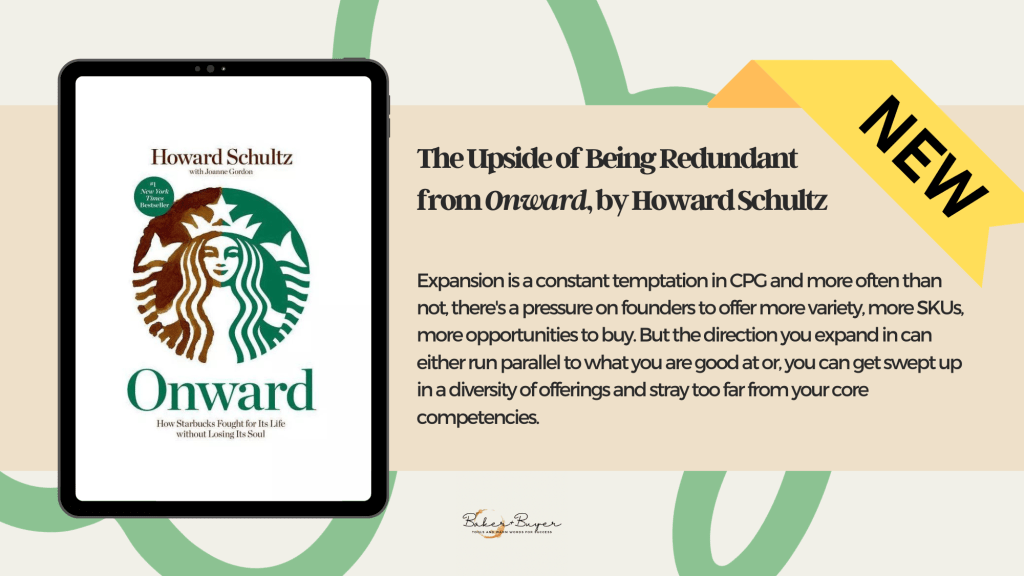
Expansion is a constant temptation in CPG and more often than not, there’s a pressure on founders to offer more variety, more SKUs, more opportunities to buy. But the direction you expand in can either run parallel to what you are good at or, you can get swept up in a diversity of offerings and stray too far from your core competencies.
Cost Per Use
From a practical and fiscal perspective, every piece of machinery you own has a cost per use breakdown.
The oven you use to bake cupcakes didn’t cost you 4k, it cost you 1k for each of the first four cupcakes you bake.
And it costs $4 for each of the first thousand cupcakes you make.
The more cupcakes you make, the cheaper the oven.
When you start baking cookies in the oven as well, the cost of the oven drops even lower.
At a certain point, cost per use slides into the negative, and that’s when your equipment is actually making you money. That’s always the goal.
Staff and customer education don’t have an identical profit structure, but both are expensive and there is an enormous potential for savings by being redundant in methods and offering.
Every time you expand your brand by using what you already have, you are creating something that your employees are comfortable making and selling and your customers are comfortable buying.

 Baker + Buyer